Jake Madsen
March 9, 2026


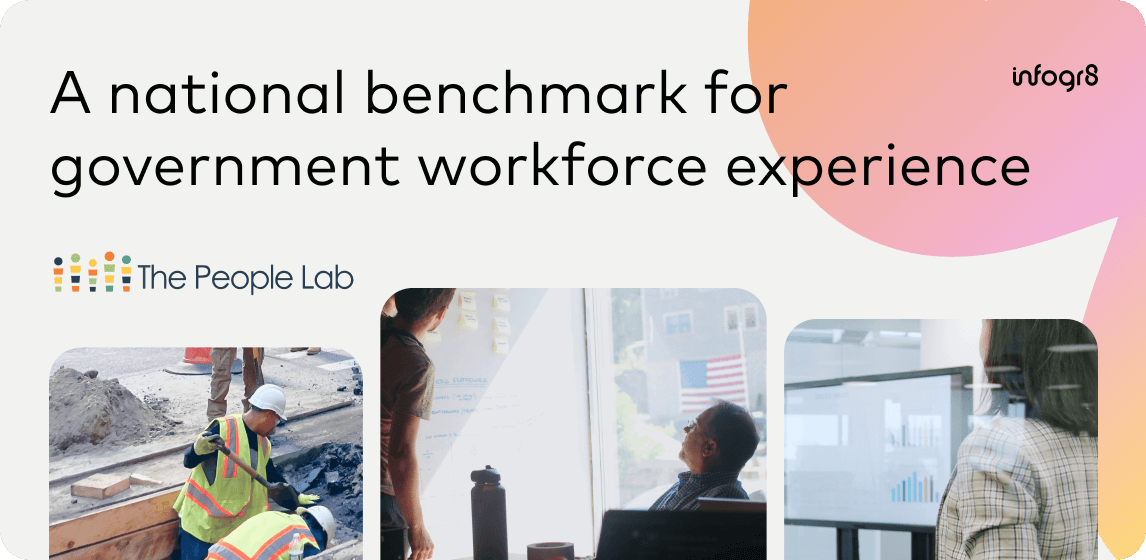
We measure almost everything in government. Except how the workforce actually feels. Their experiences. Their challenges.
Cities, counties, and states invest considerable time and resources in understanding their workforces. But most lack a clear way to see how their employees’ experiences compare nationally. That makes it harder to understand challenges in context, learn from peers, and make informed decisions about the teams that directly shape how residents experience and trust their government.
That’s why we’re partnering with The People Lab on something long overdue: a national benchmark for government workforce experience.
Using validated scales and metrics that many governments are already familiar with, the project will measure employee engagement, job satisfaction, burnout, and other perspectives across cities, counties, and states. The result will be a set of national benchmarks and a public use dataset, new tools for leaders and researchers to inform strategy and decision-making.
Beyond the data itself, the project aims to facilitate peer learning among governments, building communities of practice where cities can share insights on recruiting, retaining, and supporting their employees. And by building evidence on how workforce investment connects to resident outcomes — trust, engagement, service quality — it will help make the case for treating the government workforce as a strategic priority, not an afterthought.
Public sector workforce research has long been underpowered relative to the private sector. Policymakers and city leaders often lack the comparative evidence they need to understand whether their challenges are unique or systemic, and what interventions are actually working elsewhere.
This project aims to change that. By producing rigorous, openly available data, it will spur academic and policy research on the public sector workforce and help centre local government in broader workforce conversations where it has historically been absent.
Because the teams delivering public services deserve the same rigour we apply to everything else.
An early preview of the findings launches in April, with the full release coming this fall. We’ll share more as we get closer.

Soho Works White City,
Television Centre,
101 Wood Lane,
London,
W12 7RJ